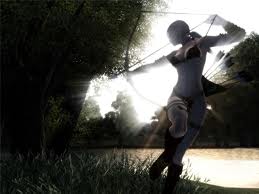
But the rest, not so much, TES always has very well lit dungeons, I don't know why but they do. My guess is someone there thinks that players don't really want to worry about light and will overlook the candles and such that seem to have been burning for 3000 years.
Back in Morrowind's time, it was standard for me to permanently graft at least 50% Night Eye onto my character just to be able to see ANYWHERE ... Admittedly, that has something to do with my not going with the "realistic" option of adjusting the lighting in my bedroom to match the ambience of the in-game environment (which would have allowed my eyes to adjust better to the lower contrast)... but either way, it was avoiding something that was basically a nuisance... without resorting to eternal candles.
So yeah... I'll throw out my two-way stance on this matter, in an either / both fashion.
#1. Ambient light without a source... get rid of it. If the light isn't obviously coming from SOMEWHERE then it probably has no business existing. Even light spells have a source.
#2. A few ways to compensate for this. The bog-standard torch is limited, and I've never found a working lantern. Light spells can be nice, but suffer similar impracticalities. I recommend bringing back the Night Eye spell, and not making it necessary to always play Khajiit for their inate ability. What I also do NOT recommend is inordinate numbers of fully functional candles and whatnot peppering every ancient barrow or whatever across the landscape. I can understand Dwemer Ruins somehow having a lot of light-sources, but ironically enough they're DARKER than the Barrows in Skyrim.
And I'm not just talking about dungeons here, incidentally.
Deciduous forests ought to be denser, especially with low-level foliage around the edges... and consequentially darker inside. Makes for a better ambience.
Coniferous forests, depending on the trees involved, ought to be adjusted similarly. I've been through quite a few. They're difficult to navigate and VERY dark... unless it is one of those top-heavy tree varieties, which is less common for conifers.

 » Sun Jun 17, 2012 12:54 pm