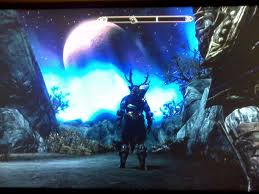
In New vegas One of the FOUR main leaders of the factions in New vegas; Ceasar has so much character and backstory and tons of dialogue I was going through it for ages because it was a joy to listen to. That beats anything that Skyrim could ever ever offer
anyway: http://www.bethblog.com/2007/09/27/inside-the-vault-mark-lampert/
the important part if you don't want to read it all:
There are over 37,000 lines of spoken dialogue in Oblivion. Discuss.
Yes, it would seem that our designers know no bounds when it comes to writing for our games. Also, consider this: at one point in development, there was almost twice that much! A figure was calculated and we knew that we could never fit that much into the game, so they all worked hard to hone it all down and still have it turn out so wonderfully.
As far as how we managed to get that many lines of finished dialogue into the game, all I can say is that no man is an island. People spent a lot of time here playing the game and testing out the dialogue in the game, and that saved a lot of trouble during recording in that there weren’t too many things to change that couldn’t wait until the shorter ‘pick up’ sessions which would follow later on. We also recorded in two studios at the same time, with me directing in one and another designer directing in another. That way we could record the voice actors more quickly, and then turn the raw recordings over to two or three editors so that we could get everything turned around and into the game in a timely manner. I edited a bunch of it nonetheless as I always have little picky changes that I want to make, plus listening through each and every file toward the end for the sake of quality control, plus post effects, plus doing the same for localized versions … but it all got done in the end at the hands of many.
I think the most critical aspect of handling enormous amounts of recorded dialogue in a game is to be ridiculously organized from start to finish. The writers have to follow certain agreed upon guidelines in order to make the dialogue work in the game, and when the massive raw script is first exported, all of that data is more or less what I start with as I format and further organize it all into something usable in the studio … something that I usually spend a full day or two doing. I need it to be easily readable and as easy to understand as possible for the voice actors, and I also need a lot of extra data for each line to direct from. Somehow that all has to get crammed into each page for each line, and everyone’s copy of the script needs to match exactly to avoid confusion which might otherwise snowball into a larger problem. It should be easy for the editor to make sense of even if it’s a matter of weeks before they start, and it all has to make sense in the months that follow when the odd dialogue bug is popping up in the game here and there. When a problem comes up because some guard’s line which is supposed to be, “Hey, you!” is actually playing as, “Hey, stop!”, I need to be able to search that line and quickly figure out what’s going on, why the wrong line or take is playing and where the correct one is hiding.
Having actual paper copies of the script to work from is a big help, too, even if it does mean a pricey visit to a local printing store. It saves everyone’s eyes, you can make notes directly on the page, the designers can write in their line changes as we adjust dialogue on the fly during the session, it’s great to edit from, etc. In the end it’s worth having. You also get to keep a full copy on your shelf to show off, too. “Those five three-inch binders completely packed full of paper? Yeah, we recorded all of that. And at one time it would have been almost twice as much!”
'nuff said
 » Wed Jun 13, 2012 6:02 am
















 )It doesn't mean it's quality and if it isn't in the right place and spread thin between loads of characters then it doesn't have much of an impact.